How to get into the Munich Residenz: which door, which desk, and what you may carry through it
Residenzstraße 1 is an address for a block. Walk the outside of it and you pass gateways, courtyards and more than one public door, and only one of them is the one you want on a given afternoon. The Bavarian Palace Administration’s own floor plan settles it in a line most visitors never see: the Residence Museum and the Treasury share an entrance on the Residenzstraße and Max-Joseph-Platz side, the Cuvilliés Theatre has an entrance of its own, and so does the Court Church of All Saints. Three ticketed things, more than one way in.
The doors of this block, and the one people miss
I have stood at the Max-Joseph-Platz corner and watched people walk the whole frontage twice.It is that the building presents several perfectly plausible public entrances and gives a stranger nothing to rank them by. If you are here in daylight to look at rooms, the museum and Treasury entrance on the Residenzstraße and Max-Joseph-Platz side is the one, and everything else at this address is a different errand.
The one that defeats people is the theatre. It is a separate ticket, a separate timetable and a separate way in, and because most visitors meet it as the third line on a combination ticket they assume it opens off the museum route. A reviewer of the gala concert put the whole problem in one sentence:
“It being our first day in Munich, we did have some difficulty finding the entrance to the theater. But once inside, everything went well. The theater is beautiful and comfortable, the music sublime.”
— Matthew Alan, on Munich: Gala Concert in the Cuvilliés Theatre
He has plenty of company, and the problem is not confined to the evening. Pascal, on the court chapel programme, names the physical cause: “Very nice atmosphere, 3 very talented musicians. Unfortunately a bit cold and difficult to find as the sign is very small.” JODY, on the same listing: “We did have a difficult time finding the entrance to the chapel but once we arrived we were not disappointed.” And Hans-joerg, who took the tour that lets you choose between this palace and Nymphenburg, wrote a sentence worth repeating: “The description of the meeting point should be more specific. Residenzstrasse 1 isn’t enough for the size of the residence. ‘Ticket counter’ is too general and hard to find.”
Whatever you have booked, and whether or not you have booked anything, work out which of the three parts you are aiming at first and go to that part’s door rather than to the address. For a daytime visit that is the Residenzstraße and Max-Joseph-Platz side; for an evening concert it is whichever entrance the listing names, and it is worth reading that line before you leave the hotel rather than in the dark on the pavement.
The ticket desk, and what you book ahead instead
Admission here is bought where you are standing. The palace administration asks for no advance reservation of any kind, so there is no timed slot to miss. The one instruction it does publish is for parties: a group of more than 25 has to divide before it goes in.
Searching for this palace turns up several bookable options. What those listings sell is the part that needs a date: a guide with the tickets folded in, a private guide, a bus that stops nearby or a seat at a concert — plain admission is the desk’s job on the day (all sixteen, and what each one hands over). If your plan is the state rooms with a handset in your ear, the whole transaction happens at a counter inside the door and takes as long as choosing between three tickets; if it is the rooms explained and all three doors handled, that is the guided visit (the tariff, and the two savings on it).
The bag rule, and the free supervised cloakroom
The operator’s wording is unusually precise, which is a kindness: no large bags from 35 x 30 x 12 cm, no rucksacks and no bulky objects may be taken into the Residence, and these may be left at the free supervised cloakroom. Read that as three separate rules rather than one, because the second is the one that catches people. A rucksack is out on its own account. It does not matter how small it is or how empty; a day pack the size of a loaf still goes to the counter.
The dimension itself is worth a second of attention if you are arriving with luggage in tow. Thirty-five by thirty by twelve centimetres is about the size of a small carry-on tote, so anything you would call a bag rather than a handbag is over the line. The cloakroom is free and it is supervised, which is not the same as a bank of coin lockers and is worth more than it sounds when what you are handing over is a coat and a camera bag on a wet February afternoon.
Deal with it on the way in. The alternative is being turned back at the top of a staircase and walking the route in reverse with a queue coming the other way, which I have watched happen and which converts a two-minute job into a bad quarter of an hour.
The audio guide, in nine languages, and what a guide adds to it
This is the fact worth knowing at the desk, and it is published on the operator’s own page in plain words: you can make use of our free audio guide, available for the Residence Museum and the Treasury in German, English, French, Italian, Spanish, Russian, Chinese, Japanese and Arabic. It is nine languages, and five of them are the five this site is published in.
Two limits, both of them worth knowing before you buy anything else. It covers the museum and the Treasury, and it does not cover the Cuvilliés Theatre, which has no commentary of any kind — the room where a live guide changes the visit most (what you are looking at in there). And it is a recording, so what it cannot do is answer the question you actually have. That is the case for booking a guide: not narration, which the handset supplies, but a person to interrupt, the theatre explained, and the three doors handled in one sequence.
The City of Munich also runs its own regular guided tours of the Residence in English and in German, bookable through its own visitor service, which is a third route between the free handset and a private guide.
Photography: yes, with two conditions
Photography and video recording for personal use are permitted in the Munich Residence, without flash and without a tripod. That is the whole rule. It is a more generous position than several other interiors in this country take, and it is worth knowing in advance because it changes what you carry: no flash and no tripod means the useful thing to bring is a lens that copes with a dim gilded room, not a bag of gear that will not get past the cloakroom anyway.
Personal use is the boundary. What the phrase excludes is commercial work, which is a conversation to have with the administration and not with the person on the desk.
Getting in after dark, which is a different problem
Most of the reviews quoted above were written by people who came for music rather than for rooms, and that is not a coincidence. In daylight the museum entrance has a stream of people walking into it and you can follow them. At half past six on a January evening there is no stream, the courtyards are dark, the sign is small and the door you want may be shut until a few minutes before the start. SÜHEYLA, who came to the Saturday chapel concert, describes the whole failure and the recovery: she reached the address on the ticket, found the door closed with nothing posted on it, was sent in the wrong direction by everyone she asked, walked round the building, and came back to the same spot to find it open.
Half an hour early, at the entrance the listing names rather than at the street number, solves all of it. Which hall each evening uses, and which gate belongs to it, is set out on the concerts page, and a longer account of one of those evenings is at the court chapel concert, reviewed.
The guided visit that starts outside
If you would rather not solve the door problem at all, one listing sidesteps it by meeting you on the street: the guided Residenz and Hofgarten tour forms up “right of the Spatenhaus at the opera entrance, Residenzstraße 12”, and its own inclusions name skip-the-line tickets to the palace along with the Treasury and the Cuvilliés Theatre, so somebody else is deciding which door you go through and when.
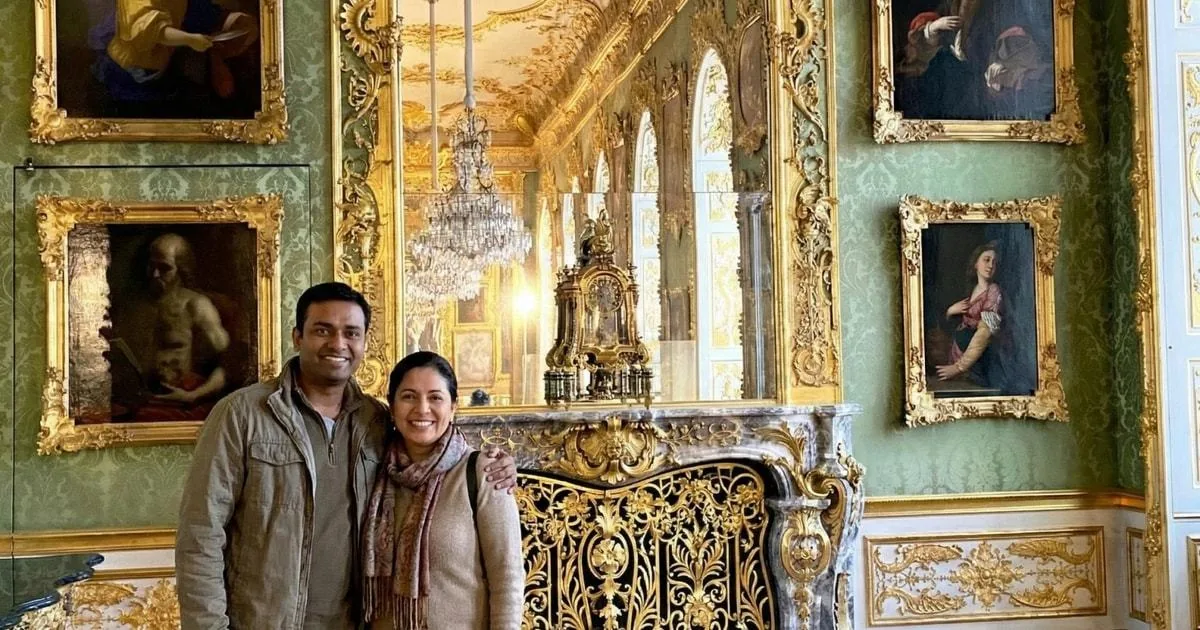 The guided one
Munich: Residenz Palace and Hofgarten Skip-the-Line Tour
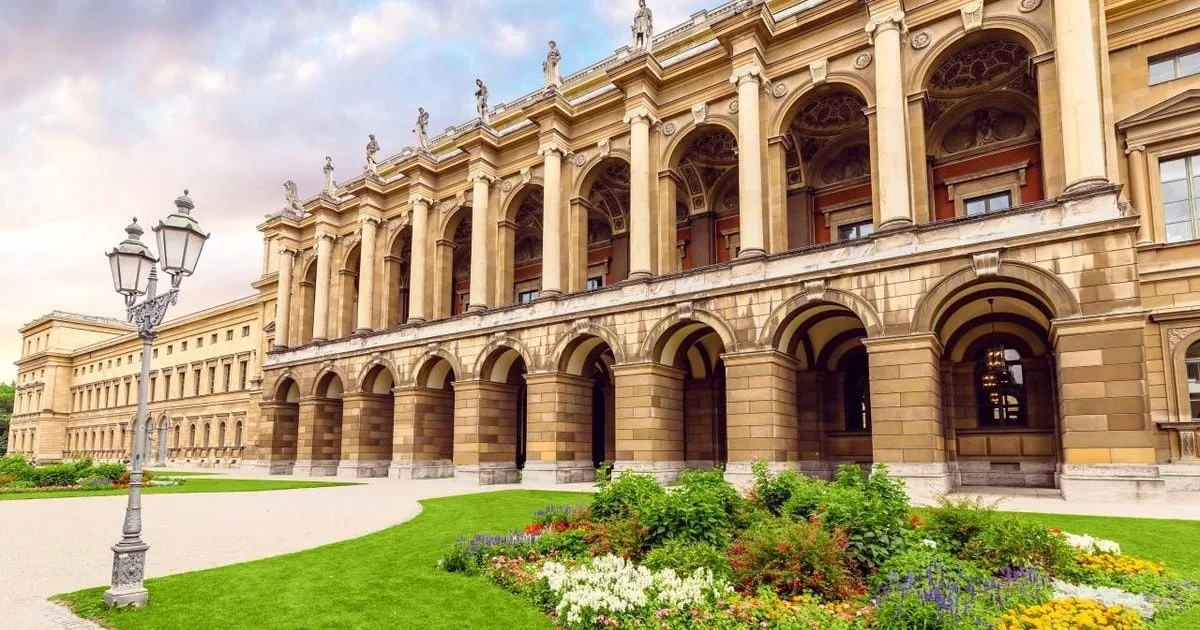 Private, all three parts
Munich: Residenz Palace, Museum and Treasury Private Tour
 Or the other palace
Munich: Nymphenburg Palace or Residenz Guided Tour
Next, in the order the day happens: what is open when, how long the three parts actually take, what you walk through once you are in, and how to reach this block from the centre.
Frequently asked questions
Which entrance do you use for the Munich Residenz?
For the Residence Museum and the Treasury, the entrance on the Residenzstraße and Max-Joseph-Platz side of the block. The Cuvilliés Theatre has an entrance of its own, and the Court Church of All Saints has a third. That is the palace administration’s own floor plan, and it is why the street number on its own is not enough: one reviewer wrote that Residenzstraße 1 “isn’t enough for the size of the residence”. How to reach the block.
Is there a queue at the Munich Residenz, and how do you get past it?
There is no timed-entry system and nothing to reserve, so what a queue means here is people at a counter rather than a booked slot you might miss. One reviewer counted it a benefit that his guide could help his party “navigate the masses at the front entrance”. Skip-the-line wording on the listings arrives attached to a guide, which is the way past the counter altogether. What each listing actually hands over.
What bags can you take into the Munich Residenz?
Nothing large. The operator’s rule is no large bags from 35 x 30 x 12 cm, no rucksacks and no bulky objects, and it names the free supervised cloakroom as where they go instead. The rucksack clause is separate from the size clause, so a small day pack is out on its own account. Leave it on the way in rather than being turned back part-way round.
Is there a cloakroom at the Munich Residenz, and does it cost anything?
There is, it is supervised, and it is free — the operator’s own wording for where large bags, rucksacks and bulky objects may be left. The audio guide, admission for under-18s and the Court Garden are free at this address too. What else here is free.
Can you take photos inside the Munich Residenz?
Yes. Photography and video recording for personal use are permitted, without flash and without a tripod. That is the operator’s complete rule for this building, and it applies to the museum, the Treasury and the theatre alike. Commercial photography is a separate matter to take up with the administration rather than with the ticket desk.
Is there a free audio guide at the Munich Residenz?
Yes. Ask for it at the desk when you buy, because it is easy to walk off without one. Counted off the operator’s own list, the languages are German, English, French, Italian, Spanish, Russian, Chinese, Japanese and Arabic. It covers the Residence Museum and the Treasury and does not cover the Cuvilliés Theatre, which has no commentary at all. What a guide adds on top of it.